


1. Issue
The Business Plan translates the “Where to” of the strategy into an actionable “how to”, usually up to an intermediate goal on the time axis. This leads to the following major steps and contents:a) Clarity of the strategy
The strategy of a company defines the following elements:- Actual situation (e.g. using the five-forces-model of Michael Porter)
- Long-term strategic goals (10+ years): Markets, products, profitability
- Basic approaches: Core competences, investment focus (FDO, JV, licensing), risk tolerance, value focus (differentiation vs. cost leadership)
b) Definition of objectives for the organizational entities of a company
Each company consists of organizational entities which have to contribute to the achievement of the objectives. The medium-term company objectives therefore have to be split into objectives for those entities (e.g. using the value chain model of Michael Porter). Such objectives have to fulfill the SMART criteria: Specific, Measurable, Attainable, Relevant and Time-related). For each objective an action plan has to be worked out, specifying what must be done by whom until when and what has to be expected in terms of outcome for benefits and costs.c) Assembling the company plan
The different plans of the organizational units have to be put together into an overall company plan. The main reason is to check whether the different plans are doable when executed in parallel or whether critical resources would be overstretched.d) Numbers
The number part of the Business Plan shows how the profitability will develop if and when the business plan can be put into practice. This first helps to check the business plan with regard to compatibility with the strategy, but then it will be the main base for the assumptions of the subsequent yearly planning (budget) and the prospective controlling.2. Potential consulting scope
- Coaching of project teams
- Training of management teams
- Review of existing business plans
- Review of existing strategic plans
3. An Example: Training of high potential young managers in value chain management
(2 day course)Objectives
At the end of the workshop the participants should
- Understand the concept of the value chain and its place within the management activities of a company;
- have applied the methodology twice;
- have drawn the elements of the value chain for their own company;
- have drafted a checklist for identifying improvement opportunities within the primary as well as within the support functions;
- have elaborated a proposal for the next steps within their own company.
Approach
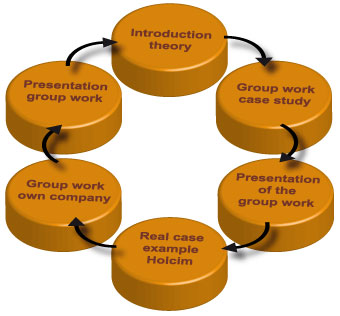
The seminar follows the scheme below: