


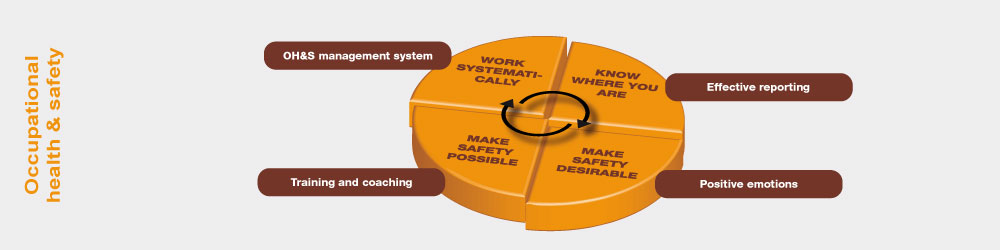
1. Issue
Companies willing to get close to the vision “Zero harm to People” and to reach world class results in OH&S must fully implement and live the OH&S wheel. This means:
a) Systematic working
A systematic approach is the foundation of any safe workplace. This is very evident when looking at the central piece of such an approach, the Hazard Identification and Risk Assessment (HIRA). If HIRA is not practiced by everybody – starting with the CEO – in a company as a matter of routine then the next accident is just waiting around the corner. Systematic working consists of several building blocks, which must be combined into an OH&S Management System. There are good practices for such a Management System available; no company has to invent it from scratch. Those good practices are all quite similar; some are more prescriptive with detailed rules, some stress more the principles.
b) Effective Reporting
“If you don’t measure it, it is not worth much” – this saying applies also to OH&S. We need to measure with lagging indicators whether we reached our goals but we need even more leading indicators, which send out warning signals. The occurrence of Near Misses for example is a clear warning signal.
c) Training and Coaching
Anybody wanting to work safely must know something and then be able to apply it to his particular work. This requires training (for the knowing) and coaching (for the understanding).
d) Create Emotions
A safe workplace needs a systematic approach with rules. But rules tend to create a culture of obligations. Safety however should be something desirable, should have a positive connotation, should even be fun. For creating those positive emotions companies need to organize events, include the families of the employees, run competitions, communicate positive results.
2. Potential Consulting Scope
Practice & Experience Ltd offers the following:
- Audit of the four elements of the OH&S wheel
- Development of improvement projects
- Management of improvement projects
- Coaching of project managers
- Temporary management of OH&S staff functions at corporate level
- Management training of top and senior managers
- Train the trainer courses
In the following the objectives and the agenda for a one-day management course are presented;
3. Safety Leadership Course for Managers
Objectives
Upon completion of this course participants will be able to:
- Perform a HIRA for any kind of activity in the field
- Understand fully their role in changing behaviors of employees
- Give effective Safety Moments
- Check existing JSAs for quality
- Do meaningful Safety Observation Tours
- Know how to conduct Incident Investigations
- Understand the Safety Policy of Oerlikon
Morning Agenda
| 08:30 – 09:15 | Introduction (with Video), Objectives, Agenda |
| 09:15 – 09:45 | Why do incidents happen? |
| 09:45 – 10:00 | The HIRA concept |
| 10:00 – 10:30 | HIRA at the Location |
| 10:30 – 10:45 | Break |
| 10:45 – 11:00 | Safety Moment: the concept |
| 11:00 – 11:30 | Development of a Safety Moment |
| 11:30 – 11:45 | Presentation of aSafety Moment |
| 11:45 – 12:15 | Safety Culture and Behavior Change |
| 12:15 – 12:45 | Four steps to Behavior Change |
| 12:45 – 13:15 | Lunch |
Afternoon Agenda
| 13:15 – 13:30 | Presentation of a Safety Moment |
| 13:30 – 13:45 | Concept of Safety Interventions |
| 13:45 – 14:45 | Job Safety Analysis |
| 14:45 – 15:00 | Work Permits |
| 15:00 – 16:00 | Safety Observation Tour |
| 16:00 – 16:15 | Break |
| 16:15 – 16:30 | Presentation of a Safety Moment |
| 16:30 – 17:00 | Incident Investigation |
| 17:00 – 17:45 | The Safety Policy and the Safety Management System of Oerlikon |
| 17:45 – 18:00 | The best Safety Moment |
| 18:00 – 18:30 | Summary and Wrap-up |
4. ABSTRACT OF THE DOCTORAL DISSERTATION “SAFETY AT WORK:
AN ISSUE OF DAILY MANAGEMENT BEHAVIOR”
Nobody wants to get harmed at work and most people have had training on how to work safely. Why then do incidents occur every day, inflicting harm? To be safe at work means to minimize the risk of getting into contact with a technical condition – mostly a source of energy – that could harm a human body upon contact. Many studies published state that the root cause for incidents is observable behavior of people and consequently concentrate on employee behavior change as the key to a safer work world. This thesis focuses on daily management behavior needed to improve safety at work.
Two models were used to gather evidence from more than 800 managers and employees of two globally active industrial companies, the first one developed by INSEAD professor Jean-François Manzoni identifying six levers influencing behavior, the second one a own development outlining four steps to go through when changing behavior. The case studies proved the usefulness of both models. Managers stated their own visible behavior to be the most important of the six levers. This insight however did not lead to a widespread involvement on their side, a lack of understanding of how to act and a reluctance to cross organizational boundaries being the strongest barriers. The four-step model showed that people can and do change to a safer behavior if and when they know, understand, accept and do (i.e. apply) safe behavior procedures and if they are supported by management acting as teachers, coaches, motivators and mentors. Teaching and coaching is usually a mission for first line- and middle managers whose didactic skills need further enhancement. Top and senior managers influence more by motivating and mentoring, both achieved by frequent Safety Observation Tours, a best practice that needs to be spread more across all functions.
Performance management today is more of a hindrance to safety than of a support. It relies far too much on lagging indicators. There is a need to develop leading ones and – a new idea – ability-oriented ones. Even with more relevant indicators employees are not necessarily incentivized by reward and recognition, preferring clarity of rules well communicated.
Two special issues conclude the thesis. The first one concerns contractor safety. Statistics show that contractor employees are more at risk. Management should accept responsibility for their safety as well which requires respecting that the contractor is another company. Consequently, solutions must be applied focusing on extensive upfront preparation and joint action during execution. The final case shows that safety can have a positive impact on legitimacy of a foreign company and create a positive spillover, influencing markets to give preference to a safer supplier.